
|
| Business |
| How 'Six Little Dragons' became the face of China's intelligent future | |
| Their stories of struggle, growth and vision offered a unique snapshot of China's AI sector, providing invaluable perspectives on how the industry has evolved and where it is headed | |
|
|
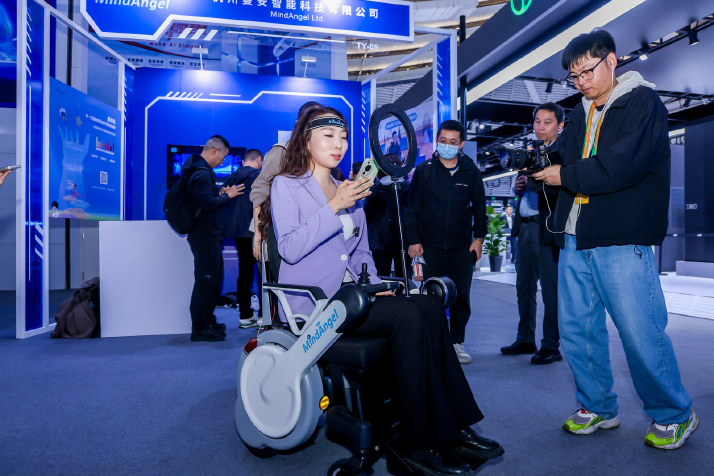 A participant of the World Internet Conference (WIC) Wuzhen Summit tries out a wheelchair controlled by a brain-computer interface device in Wuzhen, Zhejiang Province, on November 7 (COURTESY PHOTO)
Early this year, a new phrase began making waves across China's tech world: the "Six Little Dragons of Hangzhou." Each company in this group—UniTree Robotics, BrainCo, ManyCore Tech, DEEP Robotics, Game Science, and DeepSeek—is based in the capital city of the eastern Chinese province of Zhejiang and has made headlines with breakthroughs in AI, robotics and digital innovation.
Months after their rise to fame, the "Six Little Dragons" finally came together for their first-ever joint appearance at the World Internet Conference (WIC) Wuzhen Summit in Wuzhen, Zhejiang, on November 7. In Chinese culture, there's a saying from an ancient poem: A mountain need not be high; it becomes sacred with the presence of an immortal; a river need not be deep; it comes alive with the presence of a dragon. This poetic imagery was perfectly embodied in Wuzhen, a water town where rivers and bridges weave through history, and the meeting of these "six dragons" gave that verse new meaning. This year is the 10th anniversary of the vision to build a community with a shared future in cyberspace, proposed by Chinese President Xi Jinping at the Second WIC in Wuzhen. Fittingly, the conference's theme, Forging an Open, Cooperative, Secure and Inclusive Future of Digital Intelligence—Jointly Build a Community With a Shared Future in Cyberspace, brought together global guests and industry leaders from November 6 to 9, envisioning what the next era of digital intelligence might look like. The Six Little Dragons Wuzhen Dialogue, held on November 7, was one of the most anticipated moments of the conference. Their stories of struggle, growth and vision offered a unique snapshot of China's AI sector, providing invaluable perspectives on how the industry has evolved and where it is headed. 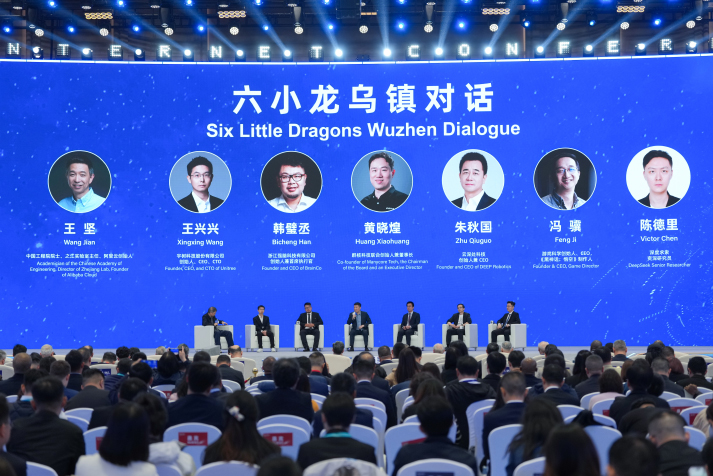 The Six Little Dragons Wuzhen Dialogue underway during the 2025 WIC Wuzhen Summit in Wuzhen on November 7 (XINHUA)
The past "In 2016, there were just three of us," Wang Xingxing, founder of quadruped and humanoid robot manufacturer UniTree Robotics, recalled. The following year, the startup brought their first robot dog to the WIC. None of Wang's team could have imagined that, less than a decade later, the company would grow to have over 1,000 people, and that their robots would catch the attention of Marc Raibert, the founder of U.S. robotic manufacturer Boston Dynamics. "I talked to Mr. Raibert at the end of 2024 and he kept bringing up UniTree. The depth of his understanding and respect for the company made me ashamed as a Hangzhou native that he knew it better than I did," Wang Jian, a member of the Chinese Academy of Engineering and founder of Alibaba Cloud, the cloud computing arm of Chinese e-commerce giant Alibaba Group, said. At BrainCo, the story began in a Harvard lab. Ten years ago, its founding team was made up of students experimenting with what was then an obscure idea: brain-computer interface (BCI). "A BCI could help a child who can't speak find their voice or help someone with chronic insomnia finally sleep," Han Bicheng, founder of the neurotechnology company. "We saw the potential to take century-old, bulky medical devices and reimagine them for the modern era, so that more people can benefit from the technology." "Picture a group of Chinese students in a basement wearing glowing headgear at 2 a.m. One night we scared an old American lady who thought we were recharging our brains to get better grades," Han recalled. According to Han, frustrated by slow research cycles in the U.S., they moved the company's headquarters to Hangzhou in 2018 and that marked a turning point for rapid growth. Huang Xiaohuang, co-founder of spatial intelligence infrastructure provider ManyCore Tech, used to work at chip giant Nvidia. "Back then, people in Silicon Valley didn't want to talk to you at social events if you were in hardware. So, I told myself I'd either join or start an Internet company," he recalled. "Ironically, I sold my Nvidia stocks to do it," Huang joked. He said his company's story mirrors the Internet's evolution. The past decade of massive user growth fueled today's AI boom. The hardware and infrastructure that once seemed unfashionable are now at the heart of the new era. In 2006, a bold prediction circulated in the robotics sector: By 2050, a team of fully autonomous humanoid robot soccer players could beat the human world champions. "I didn't want to wait until I was about 80 to see that happen," Zhu Qiuguo, founder of industrial-use quadruped robot manufacturer DEEP Robotics, said. "By 2015, Boston Dynamics had already built robots that could run and leap outdoors. We asked ourselves, could Chinese robots do that too? That question has driven us ever since," Zhu added. When DEEP Robotics first attended the 2050 Conference, a gathering in Hangzhou for young people from across the world to exchange academic insights and ideas, more than 10 years ago, their robot dog had to be suspended by two steel wires. "It sounds funny now, but at the time, our robot dog couldn't stand up on its own. We had to keep it hanging just to make it move smoothly," Zhu explained. Meanwhile, video game company Game Science, the studio behind the globally popular action game Black Myth: Wukong, has been reflecting on a decade of transformation in China's entertainment industry. In 2016, for the first time, users of simplified Chinese games on Steam, the world's largest PC gaming platform, matched users of English-language games, about 32 to 33 percent each. Around the same time, the number of moviegoers in China surpassed that in North America. "Those data points said everything: The user base for Chinese content had reached a critical mass," founder of Game Science Feng Ji said, adding that it was also in 2016 that he and his partners made a big decision to write a business plan and seek their first round of funding.  A view of the Wuzhen, a water town in Zhejiang Province and host of the World Internet Conference Wuzhen Summit, captured on November 5 (XINHUA)
The present Over the years, BCI technology has evolved from abstract laboratory experiments into innovations that can truly transform everyday life. At the Fourth Asian Para Games in Hangzhou in 2023, swimming champion Xu Jialing, born without hands, used a neuro-controlled prosthetic arm developed by BrainCo to ignite the games' cauldron. "Our technological roadmap follows a principle we call 'from pain to possibility'," Han said. "We start by helping those who need these innovations the most—people who have lost their arms or legs, or children unable to speak because of autism." For the past eight to nine years, Han and his team spent almost every day alongside these people. As their research deepens, they are expected to expand into broader fields. "Our hope is that one day, these technologies won't just restore lost abilities, but will become tools that every person can use to enhance life itself," Han said. In the next two years, the company plans to launch products focused on sleep and weight management, according to him. Encouragingly, BCI was listed among the six technologies of the future in the document of recommendations for formulating China's 15th Five-Year Plan (2026-30), adopted at the Fourth Plenary Session of the 20th Communist Party of China Central Committee in October, which further enhanced Han's confidence. At this year's WIC Wuzhen Summit, ManyCore Tech unveiled a platform that builds realistic virtual factories for robots. Before entering physical production lines, robots can be trained and tested in this digital environment, ensuring that once they step into real factories, they can operate safely, efficiently and with precision. "We began as an Internet startup, and today we've evolved into a spatial intelligence company serving not just humans, but also robots," Huang said. "Our journey reflected the shift from the Internet era to the AI era." In the age of AI, while many companies are focused on large language models, ManyCore Tech is betting on large spatial models. "In the future, each person may be served by as many as 10 robots. In that world, robots will populate not only our homes but also our workplaces and factories. To coordinate and manage these vast networks of intelligent machines, advanced spatial intelligence will be essential," Huang added. DEEP Robotics' once-wire-suspended robot has now turned into the world's first weatherproof robot capable of truly operating outdoors, one that can stand up to wind, rain and immersion. Its products are being deployed in industries such as power inspection and emergency response. Once dismissed as a pastime for the idle, gaming was long seen as something frivolous and unproductive in China. "Black Myth: Wukong proved that gaming is not just entertainment. It's the ninth art, a fusion of the eight traditional arts, literature, painting, music and more, with the most advanced technologies of our time," Feng added. Victor Chen is a senior researcher at DeepSeek, an AI development company founded in 2023. He credits the company's rapid growth over the past two years to its focus on long-term vision and commitment to open-source principles. "Open-source technology, along with the collaboration and sharing it fosters, has become one of our company's core strengths," Chen said. Wang agreed with Chen on the importance of open-source technology. A year ago, humanoid robots that could simply walk well was considered impressive. "But in recent months, we've seen robots that can dance, perform and move with remarkable agility," Wang said. He explained that China's manufacturing capabilities allow Unitree to independently develop key robotic components and create more affordable robot products. These products are sold to leading laboratories, universities and tech companies around the world. They are building software, applications and open-source AI algorithms together on the products, which has accelerated progress of the robotics industry in recent years. AI is driving embodied intelligence at unprecedented speed. What once belonged to science fiction is already becoming reality, and in the next few years, that transformation will only quicken, he predicted. The future While AI is advancing at breakneck speed, challenges still abound. Wang said while large language models benefit from the vast pool of Internet data, robots still lack a similar scale of usable data. "When it comes to embodied intelligence, everything from model design and data collection to training methods and reinforcement learning is still in the experimental stage," Wang said. Zhu summarized the robotics industry's core challenges as twofold: embodied movement and embodied complexity. The first involves enabling robots to move autonomously from one place to another without prior knowledge of their environment. The second lies in replicating the dexterity of the human hand, a goal that remains without a clear technical path. "As AI advances, we must keep asking—who is it ultimately serving?" Feng said. "If progress only concentrates technological power in the hands of a few companies or individuals, AI becomes a risk, not a blessing. The real goal should be to empower ordinary people." Chen agreed that today's AI still falls short of human consistency, being brilliant at solving complex problems, yet oddly unreliable on simple ones. The reason, he explained, is that current AI systems cannot continuously evolve in the real world after training the way humans can. "But give it 10 or 20 years, these limitations will be overcome," Chen said. "I'm an optimist about technology." "But I'm a social pessimist," he added. In previous technological revolutions, human intelligence remained the core driver, old jobs disappeared, new ones emerged, and society as a whole became more productive. But this time, intelligent machines may become smarter than people. Jobs could vanish, yet new ones may not appear. Humanity might be liberated from labor, but that liberation could shake the foundations of social order. Could humanity simply pause technological progress? Chen doesn't think so. "As long as companies seek profit and advancement, the wheel of history will keep turning. To generate higher returns, AI will inevitably be used to replace human labor," he said. Chen said in the short term, the opportunities are greater than the risks. The next three to five years will be a honeymoon period between humans and AI, in which the technology still depends on people to function, amplifying human productivity rather than replacing it. During this stage, he believes tech companies should act as "evangelists," promoting accessibility and ensuring AI benefits everyone. In the medium term, five to 10 years from now, AI may begin replacing certain types of human work. At that time, tech companies should act as advisors, helping society understand which roles are at risk, he said. Challenges will become more severe in the long term. "In 10 to 20 years, AI could take over most jobs in the market. When that happens, human society will need to redefine its order. Technology companies must become guardians of humanity, protecting people's safety and helping rebuild the social framework." Their remarks sparked wide reflection among global attendees. Balthasar Staehelin, personal envoy of the president to China and head of the Regional Delegation for East Asia at the International Committee of the Red Cross, told Beijing Review that technology will reshape societies, the challenge now is how to use it responsibly for the common good. Nii Narku Quaynor, known as the father of the Internet in Africa and Chairman of Ghana Dot Com Ltd., stressed that the true purpose of technology is to improve lives and bridge divides. "We should first use it to close gaps—and then also share the unique knowledge and expertise of the Global South with the world," he told Beijing Review. Former Belgian Ambassador to China Patrick Nijs echoed the same concern on AI governance. "We need a sustainable framework for AI governance to ensure that these technologies serve humanity, rather than humanity serving the technologies," he told Beijing Review. "Right now, there's a dangerous competition between blocs striving to dominate these technologies. That approach won't work. With 8 billion people sharing one planet, we must collaborate and share. This, I believe, is at the heart of China's commitment to global cooperation," he added. BR (Reporting from Wuzhen, Zhejiang Province) (Print Edition: From Startups to Symbols) Copyedited by G.P. Wilson Comments to zhangshsh@cicgamericas.com |
|
||||||||||||||||||||||||||||
|